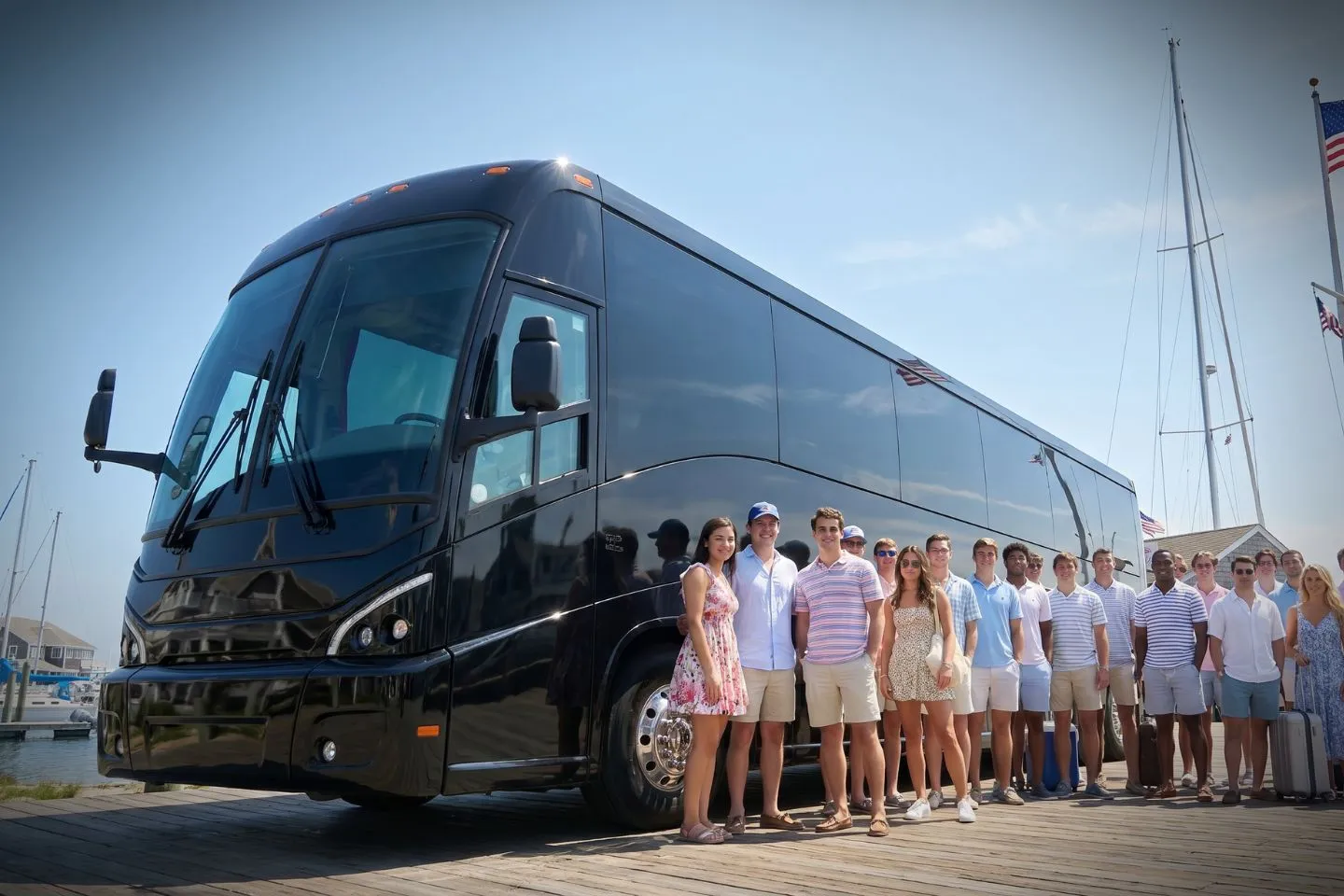
Onboard restrooms are designed for use on the road. Find out when to go and when to wait, how to walk the aisle, what children and seniors ought to do, and which Virginia highways call for extra care.
Yes, you can use the toilet while the coach is moving. The restroom on a full size motorcoach is designed for use on the road, and passengers on any charter bus trip in Virginia may walk to the rear and use it during the journey unless the driver has asked everyone to stay seated. The sensible approach is to pick a smooth, straight stretch of highway, hold the handrails, keep the visit short, and return to your seat and belt. At Legendary Limousine, we have arranged coach travel since 1997, and drivers tell us the same few habits prevent nearly every mishap. This guide explains when to go, when to wait, how to move safely down the aisle, and which Virginia roads call for extra care.
Is It Allowed, and Who Decides?
Using the onboard restroom in motion is normal practice on motorcoaches across the United States. The driver is responsible for the safety of the vehicle and may give instructions that passengers should follow.
- The welcome announcement usually covers the restroom: where it is, how the lock works, and any house rules.
- The driver may ask everyone to remain seated on a steep grade, in heavy traffic, in bad weather, or while approaching a stop.
- The restroom may be closed if it is out of order or if the tank is full.
- The trip leader is the right person to relay questions to the driver, so the driver can concentrate on the road.
If you are unsure, ask the leader or a chaperone before you stand up.
When Is the Best Moment to Go?
- On a straight, level interstate at steady speed, such as I-95 between Richmond and Fredericksburg or I-64 across the Peninsula in light traffic.
- Soon after a rest stop is ruled out. If the leader announces that the next stop is 90 minutes away, go early and unhurried.
- When the aisle is clear and nobody else is waiting at the back.
- In daylight or with the aisle lights on.
- Before you are desperate. Hurrying down a moving aisle is how people stumble.
When Should You Wait?
- On winding or hilly roads. In Virginia, this includes I-64 over Afton Mountain, I-77 at Fancy Gap, I-81 through the hills near Christiansburg, US-33 across the Blue Ridge, and Skyline Drive.
- In stop and go traffic, where sudden braking is likely. The I-95 corridor in Northern Virginia and the Hampton Roads Bridge-Tunnel approaches are common examples.
- On ramps, interchanges, and roundabouts, when the coach leans.
- In the minutes before a planned stop. The bus will be turning and slowing, and full facilities are moments away.
- In heavy rain, high wind, snow, or ice.
- Whenever the driver has asked passengers to stay seated.
- While the coach is parked with the engine off at some facilities, if the driver requests it. Ventilation and lighting may be reduced.
How Do You Walk the Aisle Safely?
- Wait for a smooth stretch and look ahead through the windshield for bends or brake lights.
- Unbuckle and stand slowly, one hand on the seat in front.
- Move from seatback to seatback, always with one hand holding on. Many coaches also have overhead rails.
- Keep your feet apart and your knees slightly bent.
- Carry nothing in both hands. Leave drinks and phones at your seat.
- Watch for bags and feet in the aisle.
- Take the step up to the restroom carefully and use the grab handle.
- Return the same way, sit down, and fasten your belt.
Flat shoes with grip help. Passengers in heels, sandals, or socks should take particular care.
How Do You Stay Steady Inside the Restroom?
- Lock the door. On most coaches, this turns on the light and the occupied sign.
- Hold the grab handle whenever you are standing.
- Sit down. Drivers and cleaning crews ask all passengers to sit, which is safer and keeps the room clean.
- Brace a hand against the wall if the bus changes lanes.
- Close the lid before you leave, to limit odor and splashing.
- Use the sanitizer provided.
- Keep it brief, so others are not left standing in the aisle.
What About Seat Belts?
Newer motorcoaches are fitted with lap and shoulder belts at passenger seats, and Virginia's seat belt guidance describes the state's rule for passengers in front and back seats. The practical advice from drivers is consistent: stay buckled while seated, leave your seat only when you need to, and buckle up again as soon as you return. A restroom visit of two or three minutes on a smooth road is a small, managed exception. Standing in the aisle to chat for twenty minutes is an avoidable risk.
What Should Children Do?
- Younger children should be accompanied down the aisle by an adult or chaperone, who waits outside the door.
- Explain the lock before the trip, including how to open it.
- One child at a time.
- Seat chaperones near the rear on school trips to supervise the queue.
- Encourage a visit at every stop, which reduces trips in motion.
- Ask children to tell an adult before they leave their seat.
Teachers often set a simple rule: raise a hand, wait for a nod, and go when the road is straight.
What About Older Adults and Passengers With Limited Mobility?
- Choose an aisle seat toward the rear to shorten the walk, or toward the front if you plan to rely on rest stops.
- Ask a companion to walk behind you.
- Request stops at shorter intervals. Many senior groups schedule one every 90 minutes.
- Tell the leader about any balance concerns before departure.
- Remember the step. The restroom floor is usually raised, and the space is too narrow for a walker or wheelchair.
For passengers who cannot safely walk a moving aisle, the right plan is frequent stops at accessible rest areas, with a lift equipped coach requested in advance.
Is It Different at Night?
On overnight runs, the cabin lights are dimmed so passengers can sleep. Floor level aisle lighting stays on in most coaches, and the restroom light comes on with the lock. Use the reading light at your seat while you get up, move quietly, and avoid shining a phone at sleeping neighbors. Drowsy passengers are less steady, so take an extra moment to wake fully before you stand.
What if You Feel Unwell on Board?
Motion sickness is more common at the rear of the bus, on winding roads, and when reading. The restroom is a small, enclosed, moving space, which can make nausea worse.
- Tell the trip leader early. A short stop for fresh air is usually the best remedy.
- Move to a seat near the front and look at the horizon.
- Open the overhead air vent.
- Use a sickness bag at your seat if one is provided.
- Sip water and avoid heavy food.
Drivers are always willing to make an unscheduled stop for a passenger who feels ill.
Which Virginia Routes Are Smooth, and Which Need Care?
Generally Comfortable
- I-95 from Petersburg to Fredericksburg outside rush hours.
- I-64 from Richmond to Williamsburg and Newport News.
- I-85 toward the North Carolina line.
- I-295 around Richmond.
- US-460 and US-58 across the flat country of Southside.
Wait for a Better Moment
- I-64 between Charlottesville and Staunton, over Afton Mountain, where fog is also frequent.
- I-77 near Fancy Gap, a long grade known for wind and fog.
- I-81, where heavy truck traffic brings frequent lane changes and braking.
- I-95 and I-395 in Northern Virginia at peak times.
- The Hampton Roads tunnels and bridges, with queues and lane merges.
- Mountain routes to Shenandoah National Park, Wintergreen, and the Homestead area.
On a trip that includes both kinds of road, use the restroom during the easy miles.
Why Do Drivers Prefer That You Use Rest Stops?
- Safety: seated, belted passengers are the least exposed in a sudden stop.
- Tank capacity: the holding tank is finite and lasts longer when most visits happen off the bus.
- Comfort for the rear rows.
- Driver breaks: federal rules cap a bus driver at 10 hours of driving after 8 hours off duty within a 15 hour duty window, and regular pauses support alert driving.
The onboard restroom is there for the times between stops. A good itinerary uses both. Stop planning by trip length is set out in whether charter buses have bathrooms in Virginia.
How Can You Prepare Before Boarding?
A little planning reduces the number of trips down a moving aisle.
- Use the facilities at the pickup point shortly before departure.
- Go easy on coffee and large drinks in the first hour, then sip steadily.
- Wear stable shoes and clothing that is simple to manage in a small space.
- Keep tissues and sanitizer in a pocket, so your hands stay free.
- Stow bags under the seat or overhead, leaving the aisle clear for everyone.
- Take any regular medication on schedule, and tell the leader if it affects how often you need a stop.
- Ask about the stop plan when you board, so you can time your visits.
Does Your Seat Choice Matter?
It does. Each part of the cabin has its advantages.
- Front rows: the smoothest ride and the best view of the road, which helps with motion sickness. The walk to the restroom is the longest.
- Middle rows: a balanced choice, between the axles, with a moderate walk.
- Rear rows: a few steps from the restroom, with a livelier ride, engine noise, and passing foot traffic.
- Aisle seats: easy to leave without disturbing a neighbor.
- Window seats: better for sleeping, with a neighbor to step past.
Passengers who expect to use the restroom often are well placed in an aisle seat in the rear third. Those prone to travel sickness should sit forward and rely on scheduled stops. On assigned seating trips, tell the organizer your preference when you sign up. Gratuity for a driver who looks after your group well is covered in how much to tip charter bus drivers in Virginia.
What Should the Trip Leader Announce?
A thirty second briefing at departure prevents most problems.
- "The restroom is at the back on the right. The door locks from inside, and the light comes on when you lock it."
- "You may use it while we are moving. Please wait for a straight stretch and hold on as you walk."
- "Only toilet paper goes in the toilet."
- "Our next stop is in about two hours at a rest area, for twenty minutes."
- "If the driver asks everyone to stay seated, please wait."
- "Tell me if you feel unwell or need an extra stop."
What Is Good Etiquette for a Moving Coach?
- One person in the aisle at a time where possible. Wait in your seat until the occupied light goes off.
- Keep visits short.
- Leave the room as you found it.
- Report a problem such as an empty paper roll or a blocked bowl to the leader.
- Keep the door closed when the room is empty.
- Do not use it for changing clothes, smoking, or vaping. Smoke detectors are fitted on many coaches, and smoking is prohibited on board.
- Do not distract the driver with requests while the bus is moving.
What if the Coach Has No Toilet?
Mini charter buses for 24 to 35 passengers and Sprinter vans for 10 to 14 usually have no restroom. On these vehicles, nobody should be walking about while the bus is in motion. Plan a stop every 90 minutes to two hours, announce a restroom visit before departure, and give passengers a discreet way to request an extra stop. If your group needs onboard facilities, a 56 passenger coach is the answer. Costs for each size are in the average cost of a charter bus in Virginia, and the vehicle types are explained in the difference between a charter bus and a coach bus in Virginia.
What if the Restroom Is Locked or Out of Service?
- Tell the trip leader, who will speak to the driver at a safe moment.
- The driver will add a stop at the next suitable exit or rest area.
- Do not force the door. It may be closed for a reason, such as a full tank or a fault.
- After the trip, if a working restroom was promised in writing and was unavailable, raise it with the company.
Which Questions Come Up Most Often?
Will the Toilet Flush on the Highway?
Yes. The system works the same whether the bus is parked or moving. Waste goes into a sealed holding tank that is emptied at the garage.
Will Other Passengers Hear or Notice?
Road and engine noise at the rear of a coach is considerable, and the door is solid. The occupied light simply tells others to wait.
Is It Bumpy at the Back?
The rear of the bus sits over or behind the drive axle and can feel livelier on rough pavement. This is the main reason to choose a smooth stretch.
Can the Driver See Me Walking?
Drivers use an interior mirror and are aware of movement in the aisle. They cannot watch continuously, so your own care matters.
How Do You Choose a Safe Charter Company?
A well maintained coach with a trained driver is the foundation of a comfortable trip.
- Federal safety information: the FMCSA's guidance for travelers and trip planners shows how to review a bus company before an interstate trip.
- State authority: for trips inside Virginia, search the DMV's list of licensed transportation services.
- Insurance: request the certificate.
- Vehicle: ask the model year, whether seats have belts, and whether the restroom is confirmed in writing.
An Example
A Virginia Tech alumni chapter in Alexandria charters a coach for 50 to a home football game in Blacksburg, about four and a half hours away. The organizer briefs the group at 6:30 a.m. and plans one stop near Staunton. For the first two hours on I-66 and the northern part of I-81, passengers use the restroom freely on straight sections. South of Roanoke, as the road climbs toward Christiansburg in heavy game day traffic, the driver asks everyone to stay seated, and the leader repeats the request. Nobody is caught out, since the group had been told when the easy miles would end. The return trip follows the same pattern in reverse, with a dinner stop in Harrisonburg.
How Do We Plan Comfortable Coach Trips?
Legendary Limousine arranges coaches for 56 passengers, mini charter buses for 24 to 35, and Sprinter vans for 10 to 14, shown on our fleet page.
- Restroom equipped coaches confirmed in writing.
- Rest stops planned with you, matched to the route and the group.
- Dispatch 24 hours a day at +1 (718) 221-4771.
- Professional drivers. Every driver is background checked, professionally trained, and familiar with local routes.
- Plain answers about the operator: our base is in Brooklyn, New York, and Virginia bookings may be performed by vetted local partners. Ask us which operator and which DMV authority cover your trip.
Book a Coach and Travel at Ease
You can use the toilet while the coach is moving in Virginia, provided you choose a smooth stretch, hold on, and follow the driver's instructions. Pair the onboard restroom with planned stops, and brief your group at the start. To reserve a coach, call +1 (718) 221-4771 or contact Legendary Limousine online, and Legendary Limousine dispatchers will confirm the vehicle's features and send a written quote.

Charlotte P. Trujillo
- Filmmaker
- Novelist
- Playwright & Content Editor
An experienced content writer specializing in clear, engaging, and research-driven content for digital audiences. Skilled in creating SEO-friendly website content, blog articles, service pages, and marketing copy that aligns with…